Thursday, October 7, 2010

The Bumble in the Jungle


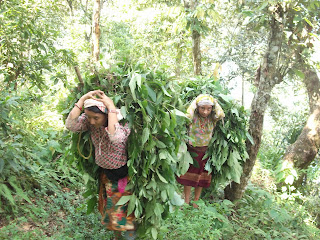
We decided to check out the farm that WWOOF (World Wide Opportunities in Organic Farming) had recommended for us to volunteer at in the Pokhara area.  With a general sense of where we were going we took some buses to Begnas Tal (the lake we had boated across a few days prior).  When we got to the Bazaar we asked the locals if they knew where the town was or if they knew the man we were supposed to meet.  No one had a clue, but that didn’t stop us from confidently striding into the jungle around the lake to find our farm.  As we traversed along a sketchy trail, and almost wound up in the lake a couple times, it became apparent that we were hopelessly lost. Instead of turning back and risking humiliation in front of the fisherman and boatmen who told us not to go that way, we forged on, climbing up the hill.  Eventually we heard voices and saw some women cutting grass that they carry in large bundles back to their homes to feed their animals.  They were slightly shocked to se us but some of them spoke a little English and with our little Nepali we were able to communicate.  We tried to help cut the grass for them but we were so slow and inept that they couldn’t suppress their laughter and didn’t feel we were up to the task. We did get to help carry the bundles on our heads though.

Eli with the pirate look and "asi" in hand

So happy to be cutting grass for goats
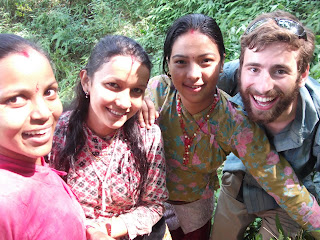
Now the women in Nepal are strikingly beautiful. These grass-cutting village people were no exception.  We made our intentions clear by telling them we were looking for wives and Eli pointed out the one he was most interested in: Susma. The phrasebook came in handy as we tried our hands at flirting: "Do you come here often?" "You wanna get out of here?" and "We're together but not married." We were both crushed when the drew their wedding necklaces from their work-tunics and showed us that they were all married already, but Eli remained persistent with Susma whose husband was working in Dubai, and therefore shouldn't really matter. Max made his intentions clear as well by telling them that wanted to buy a goat or as they say bakra.We might not have been fully successful, but we did manage to score some phone numbers and email addresses.
Rasne, Susma, Prito-something, and Eli discussing possible dowries

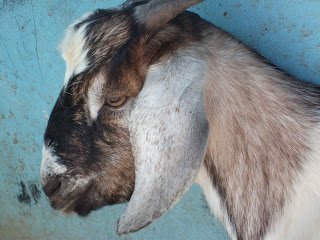
Baaaahhhhh-kra: 5000 Rupees


As we followed them back to their village suffering through leech bites, they told us the jungle was a very dangerous place for sete (whites), due to the tigers and rhinos that never appeared.  Once we got to their village we were surprised to discover many sete working to build bamboo houses in the village. I turned out that Habitat for Humanity was building 40 houses with 500 volunteers most of them from the US. After repeated marriage proposals, both to women and bakras, and promises of taking them from the jungle to America, the Acclimates left, empty-handed and heartbroken but with an expanded vocabulary (we can now compliment ladies’ umbrellas, apparently a solid pickup line). Also, we later decided that our refusals might have been due in part to the no ram ro (not nice) phone and ringtone of Eli’s recently purchased mobile, an unexpected embarrassment in the jungle, that brought more derisive laughter upon us. Eventually we caught a ride in a truck with a floor covered in liquor bottles, both empty and full, that brought us back to the Bazar. Without wives, goats, good phone, but delighted nonetheless, the Acclimates headed back to Pokhara to indulge in some retail therapy by purchasing the hip t-shirts that the cool young Nepalis wear. Maybe if we don our new Deathnote t-shirts and grab some fancy phones, we can return to the village and finally grab us some of that sweet marriage. Also, we never found the farm.
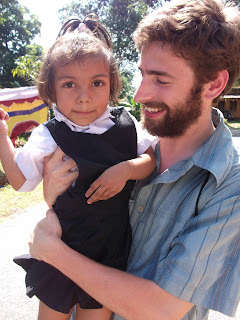
Eli and Rasne's daughter, Kripa

Sunday, October 3, 2010

What the Trek

Home Sweet Home on night 2


Defying the throngs of guides offering their services across Nepal, Max and Eli decide to pack up their tent and stove, and move into the Himalayan foothills in search of adventure.
The trek began by marching straight out of our guesthouse and walking all the way East out of Pokhara until the buildings and bustle of the city was replaced by small stone houses and incredible landscapes. We walked for over three hours until we could walk no more: literally, the road ended in a big river. So being the adventurers that we are, we took off our boots and socks, and followed a gaggle of laundry-minded Nepali women, only gently cussing under our breath as we looked fondly at the suspension bridge overhead. Once across the river we climbed enormous bales of rocks tied together with wire and found ourselves on a path at the edge of the jungle. We continued up the path of (not so) conveniently placed rocks, quickly climbing around 2000 feet in elevation. By the time we reached the first village, we were rather desperate for pani  (water) but luckily there was some type of well next to the path filled with cool but possibly poisonous water; fortunately we were equipped with iodine and rid the pani of any impurities.
Walking into the village we were immediate celebrities. After a brief conversation in sign language, we explained that we were looking for somewhere to pitch a tent and three women sent us onwards and upwards to the next village. An older man walked us up a path into a village of about 20 houses complete with a bunch of teenagers playing soccer. We threw up our tent and then joined the boys in a vigorous (and humbling) game of volleyball. Fatigued and starving, we excused ourselves to cook our dinner of baked beans, green peas, and tuna, much to the entertainment of our teammates who packed around tightly to watch. Exhausted we fell asleep at the edge of the volleyball court (dirt, obviously).
We awoke all too soon to the gentle calls of “good morning” and “what are you doing?,” to which we could only reply, “sleeping.” We exited to find a growing number of women of all ages, very interested in our belongings and seemingly infatuated with our peanut butter. After a quick breakfast (porridge), we started off further into the jungle crossing rice paddies, waterfalls, miniscule villages, and treacherous slippery rocks until we found the road to Kalika. [Quick sidenote: up until this point we knew the name of the river we had crossed, but outside of that really had no clue where we actually were, luckily everyone knew, and could understand our pronunciation   of “Kalika,” and pointed us in the right direction].


Max tries to pack up while we are peppered with questions by curious onlookers

In Kalika we rested our weary feet at the first establishment that resembled a restaurant; unfortunately it also turned out to be home of the World’s Most Expensive Dal Baht, the national dish and notoriously cheap eat of Nepal. We continued on for a few hours, further up the hills (which by the way, any American would refer to as a mountain) until we reached what we thought was Tawaridanda (which it was?). After contemplating taking over a seemingly abandoned home for our own, a friendly man convinced us that there were great camping spots just further down the road, and he was right.
We set up shop next to a local government building with a beautiful lawn, handed out a few balloons and pens to some passing children [it’s all pens, balloons, and chocolate with these kids], cooked up a delicious Nepali Ramen dinner (far superior to USA Ramen), and passed out. The next morning, we once again awoke to giggles; little did we know that word of white faces with pens and balloons would travel like wild fire across the countryside; within ninety minutes of leaving the tent at least a dozen locals were hounding us for more pens (including a particularly adamant grandmother), and we had to resist the adorable faces to teach an important lesson about entitlement and the word “please.” Eventually, Eli even had to resort to the nuclear option “bhahg” (“get lost”), which only amplified the giggling.

These kids REALLY like balloons and pens


                                                                                         A typical village home


Already exhausted but riding high on a moral victory, we set down the path to a big lake, Begnas Tal, again through the sweltering jungle until we came to the river delta. We said we wanted a boat to cross the lake and save our feet, and a young man explained that there would be one any minute. In the meantime, we were free to chat with children and listen to this young man’s cell phone as he blasted distorted versions of songs we had never heard [this has been one of the most intriguing discoveries of our trip: many Nepalis have “mobiles” nicer than our own, and perpetually play music on them no matter what they or anyone around them are doing at the time. Even in some of the smallest villages we passed, there were cell phone sightings. It’s strange]. After ninety minutes, repeated demands for pens, balloons, chocolate, and money, it became apparent that no boat was coming any time soon, so we took off down the river, accompanied by two kids. After twenty minutes of walking in a bog, and Eli almost drowning in “quick-mud” (really, up to his thighs), we found the legendary boat, complete with boatmen. Boat supply was incredibly low for a lakeside community, and demand increasingly high, so we accepted the scam-tastic rate that was offered (slightly brought down by Eli’s ingenuity) and after an hour we were across the lake.
Crossing Begnas Tal on a rather expensive boat ride


Now we know we said we would be gone for 4-8 days, but sitting in a restaurant in what turned out to be a major town with ample bus transport, the Acclimates decided that the mini-trek had been a success and that we would resupply our cache of pens and return to the jungle soon. We hopped the first bus back to Pokhara smelling of bog and tropical sweat to recharge and seek the next adventure.    

Wednesday, September 29, 2010

You Do the Hokey-Pokhara and Turn Yourself Around: That’s What It’s All About

Beautiful Lake Fewa from Lakeside, Pokhara

We woke up at 545, just like the good ol’ days of Kopan, and hurried ourselves to a long line of tourist buses ready to leave for Pokhara. Accompanying us were two Dharma Friends: Joel, a Singaporean our age, and Benedikt, a German Med student and all around tubular dude. We soon found out that Sarah, our Finnish friend was on the bus behind us. It took about 7 hours of winding mountain paths through jungle canopy and nearly tipping into bottomless gorges, but our steady ride finally came to a close in the beautiful city of Pokhara.
We’ve been staying in “Lakeside” beside Lake Fewa, and what a lake it is! Although the monsoon clouds are slowly drifting away, we did manage to catch a couple glimpses of some of the tallest peaks in the world, and there are sure to be many more peeks of peaks soon. Pokhara feels like some small beach town in Central America: the water makes everything cool, the streets are wide and quiet, and the people are incredibly friendly. The only big difference is that we’re surrounded by foothills and the Himalayas are within reach to the north. Such a relief from the congested crazy of Kathmandu.
The first full day in Pokhara, we chose to hop in two canoes (now joined by Sarah’s Swede friend Elenore), and were dropped off at the bottom of a tall jungle hill. Our first real taste of climbing up an elevation, a couple of hours later we were standing at one of the World Peace Pagodas and looking out over the whole lake and valley. After numerous clock-wise laps around the stupa, we head down the other side of the hill to the famous Devi’s (Davi’s? Davis? It was unclear) Falls. After hanging around for a moment, we hitchhiked on a passing tractor back towards Lakeside. Our next day we spent lounging about on the lake with our friends (minus Joel but plus Elenore’s brother Isaac, pronounced E-Sak ), and fortunately got into the dock just before a monsoon erupted. Our friends were all leaving the next day so we hit up the Busy Bee and enjoyed a couple adult beverages and some live music. It was a sad goodbye but as we learned in the monastery all things are impermanent, plus, we happened to run into another Dharma friend the next day.
Tomorrow we are planning to head out on our first trek; we’re being courageous and designing our own route through dozens of small villages, many of which rarely see two white faces. We’ll be staying in our tent and cooking over our stove unless some Nepali family decides to take us in. With a compass and a map as our only guides, there is guaranteed adventure ahead. It may be 4-8 days until we have email again so wish us well and we’ll tell you all about it soon.  

Hitching a ride on a tractor after a long hike

Max heroically captaining a vessel on the lake

Eli and Max's new friends (Left to Right: Isaac, Elenore, Sarah, and Benedikt)

Finding peace at the Peace Pagoda

Wednesday, September 22, 2010

Om on the Range: The Dharma Dudes and Their Little Lama Mama

After over a week amid the chaos, noise, and flute-hawkers in Kathmandu, we were exceedingly ready for a different scene. The Acclimates, accompanied by almost 40 other spiritually-parched individuals from about 15 countries, found themselves up in the foothills 25 minutes north of the city at Kopan Monastery, surrounded by misty mountain tops and over 300 Buddhist monks.

Kopan is a world-famous monastery that studies and teaches Gelug-pa Tibetan Buddhism and was featured in the film “Little Buddha,” about searching for the reincarnation of a Lama. There was a lot of really interesting, soothing, and mind-blowing experiences (do yourself a favor and google seach Lama Relics: we saw hundreds of these in glass cases, all from one man), too many to explain here, but most importantly, we enjoyed ourselves immensely and learned a great deal.

During our ten-day stay, we enjoyed a rigorous schedule, including half-day silence until after Lunch:

5:45 Wake up
6:00 Morning Tea
6:30 Meditation
7:30 Breakfast
9:15 Morning Lessons
11:30 Lunch
2:00 Discussion Groups
3:30 Afternoon Lessons
5:00 Tea
6:00 Meditation
6:45 Dinner
7:45 Final Q and A, then Meditation
9:15 or so Bed Time

And that was only for the first week, after that we started a 2 day silent retreat that dropped the lessons. Although some of the main tenets of Buddhism do not exactly correlate with the Acclimates’ worldviews, there is so much good in the teachings that the course did mange to restore some faith in organized religion. We won’t bother everyone with the extensive wisdom we received during hours (and hours) of lessons, but if anyone has any questions about the Dharma, Karma, or our homeboy Shakyamuni, feel free to ask.

Our teacher Ani Karin:
Our teacher Losang Sherab (on Facebook!)

Maybe the best part of the course was the great group of people we met. After spending over a week discussing and debating the technical details and merits of Buddhist theory, everyone let their hair down in Thamel last night when 25 of us met for a raucous, vow-shattering, four hour dinner. It was an evening filled with the quenching of prolonged beer-thirst, hand-rolled cigarettes, and incredible good vibrations among the Dharma Friends.

Now the plan is to meet up with a couple Buddha-Buds and grab a bus tomorrow and head out to Pokhara; the trekking capital of Nepal.
Saturday, September 11, 2010

off to new things

Today we leave for the Kopan Buddhist Monastery. We are doing a beginners retreat that will last for 10 days. We might not have access to the internet during that time so don't expect us to update the blog, but we will tell you all about it when we are done. Until next time...

Thursday, September 9, 2010

These are pictures of the two Durbar Squares and from the Boddahnath Stupa.

Wednesday, September 8, 2010

Visas and Vishnus

So we've been really busy in the last few days; exploring new parts of Kathmandu, learning how to circumvent the all-too-polite scam artists, discovering the Samosa Queen and her tasty, flaky delicacies. Thus far, the theme of the trip has been striding confidently into unknown territory; permitting our sharp wits and destiny to guide us, and so far so good.

Here's a little history for everyone: in 1482 the Kathmandu Valley was split into three kingdoms: Kathmandu, Patan, and Bhaktapur. Since unification, the best way to see evidence of the former kingdoms is from the Durbar (or Palace) Squares, which are filled with beautiful (and often enormous) temples, shrines,  and palaces. These buildings look like something straight out of Indiana Jones, like there should be armies of undead warriors running through the streets or something.

So far we've walked to the Patan and Kathmandu Durbar Squares, both with incredible and unique Newari architecture. We saw the building that houses the Kwari Devi, a living goddess who is a prepubescent girl that waves from her window and rides a yellow chariot around the city only 6 times a year. After puberty starts, she gets kicked back into mortality, and a new Devi is sought after. In Patan we walked through a fantastic museum that explained much about Hindi and Buddhist art from the last 1000+ years, accompanied by magnificent examples. We learned about some of the gods, but there are 33 million of them so....


We're having dinner with our friend from the flight over, Prakriti, and her family tonight, so we've got to go grab them a gift. Later!